


Flanders has new regulations related to public real estate transactions
On 1 June 2024, a new Flemish decree dated 8 March 2024, came into effect that provides for how real estate assets are disposed of and rights in rem are established and disposed of. The purpose of this decree is to create a sustainable, consistent and effective legal framework within which entities of the Flemish government can dispose of real estate assets, as well as establish and dispose of rights in rem. The main consequence of this decree is that from now on all Flemish public authorities and entities must comply with well-defined publicity obligations in connection with their public real estate transactions, whereas previously this was only the case for a more limited circle of authorities.
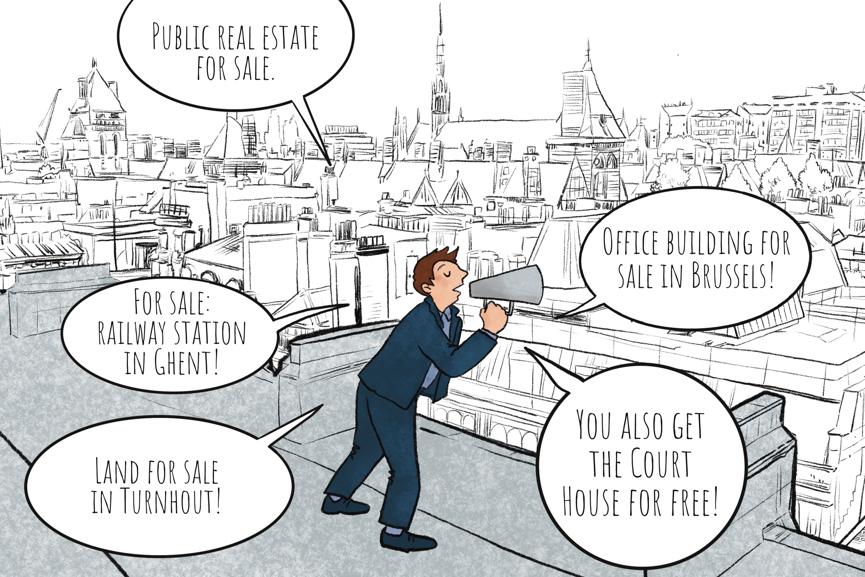
1. Regarding public real estate transactions in general
The term “public real estate transactions” refers to selling, exchanging land, establishing rights in rem such as ground lease or superficies, renting or leasing, etc., of land and/or buildings belonging to state ownership.
It is important to note that, in principle, public real estate transactions are not subject to public procurement legislation, which means that the stringent rules of this legislation do not have to be complied with.
In exceptional cases, a public real estate transaction will be considered a public procurement contract. This will be the case when a transaction is accompanied by the government’s request to carry out certain works or improvements to the property and the main object of the agreement meets the definition of a public works contract. In this case, the government concerned will have to comply with the public procurement law and follow the procedures stipulated therein. Specifically, this means that the transaction will have to be advertised and put out to competition.
Public real estate transactions must always adhere to the principles of equality, non-discrimination, and transparency, even if they are not subject to public procurement legislation.
Compliance with the transparency principle primarily requires that appropriate publicity be given before entering into the contract.
2. The previous regulations of the new decree on public real estate transactions
In the past, various instruments were already issued regarding public real estate transactions, as a result of which transactions not governed by public procurement law also had to be subject to publicity measures to a certain extent.
Reference can thus be made to the Decree of 30 November 2018 on the disposal of real estate assets or Article 293 of the Decree of 22 December 2017 on local government, which already put forward certain principles of competition, transparency and proportionality.
These provisions were further concretized by the Flemish Government in the RD/ABB Circular 2019/3 on real estate transactions by local and provincial administrations and by administrations of recognized honorary services. This circular contains various guidelines regarding the procedure to be followed by these authorities in managing and disposing of their immovable patrimony.
3. What are the impact and consequences of this new decree?
The new decree creates a clear(er) regulatory framework for Flemish public authorities, and provides an explicit legal basis for the application of the principles of transparency and fair competition with respect to all public real estate transactions.
First and foremost, the decree provides for an extension to all Flemish public authorities of the obligation to disclose by “appropriate and proportionate publicity measures”, which was already provided for in the Decree of 30 November 2018. Indeed, before that, a number of public bodies escaped the scope of the decree framework. From now on, the term “Flemish public authority” should be interpreted very broadly.
Furthermore, according to the decree, in order to determine which publicity measures are appropriate and proportionate, the value, condition and location of the property as well as the market situation must – as in the Decree of 30 November 2018 – be taken into account. In other words, appropriate publicity will depend on the concrete context of the transaction. Thus, a public sale will not automatically be mandatory. A market consultation, for example, or a public announcement through an official channel may also be appropriate.
Finally, the decree explicitly provides for three exceptional cases in which very limited transparency and competition may suffice, notably when:
- the estimated value of the property to be disposed of or the full term of the right in rem is less than 37,500 euros;
- the transaction takes place in pursuit of objectives of public interest;
- it can be reasonably assumed that the transaction could seriously harm the economic and financial interests of the Flemish Government concerned.
In these cases, it will still be possible to proceed with a direct private transaction.
4. Power of the Flemish Government and parliamentary authorization
The decree stipulates that the Flemish Government is competent for public real estate transactions concerning real estate owned by the Flemish Community or the Flemish Region. Only if the estimated value of the transaction exceeds 10,000,000 euros will a prior authorization of the Flemish Parliament be required.
Note: The decree is only applicable at the Flemish level. The disposal of federal domain property is today still governed by the outdated Law of 31 May 1923 on the alienation of immovable domain property.
Would you like to receive more information or be assisted by the specialists of Andersen in Belgium (formerly Seeds of Law)? Please do not hesitate to contact us at +32 (0)2 747 40 07 or at info@be.Andersen.com.

Discover more about this topic?
I am looking for a specialist in





See more articles

05.10.2026
•NEWS FROM THE FIRM
Luc Herve joins Andersen as the firm opens a new office in Liège
We are pleased to announce that Luc Herve's law firm has joined Andersen in Belgium, which opened a new office in Liège in September. Luc Herve joins Andersen as a Partner, bringing more than thirty years of experience in tax law, alongside his academic work and role as an accredited mediator. He is joined by Jérémy Lerusse, Associate. Both are members of the Liège Bar.

01.10.2026
•Real Estate, Renting and Co-ownership, Andersen in Belgium
New Code of Ethics for Real Estate Agents: More Than a Mere Update
On 21 September 2026, the Royal Decree of 20 July 2026 approving the new Code of Ethics of the Professional Institute of Real Estate Agents (BIV) was published in the Belgian Official Gazette. The new Code enters into force on 1 October 2026, the date on which the 2018 regulations are repealed.
29.09.2026
•Urban Planning and Environmental Law, Andersen in Belgium
Financially contributing to a spatial implementation plan (RUP) poses a risk to your permit
A developer who contributes financially to the drafting of a spatial implementation plan may thereby jeopardize their integrated environmental permit. This follows a ruling by the Council for Permit Disputes dated September 17, 2026. The ruling addresses a practice that is widespread throughout Flanders.

17.09.2026
•Urban Planning and Environmental Law, Andersen in Belgium
Health organisations to become part of the public concerned in urban and environmental permitting procedures
Non-governmental organisations dedicated to protecting human health will soon be able, like environmental protection organisations, to qualify as part of the “public concerned” in urban and/or environmental permitting procedures. This will broaden the range of organisations that may challenge a permitting decision, adding a new dimension to future permitting procedures.