


Small companies, large tax breaks
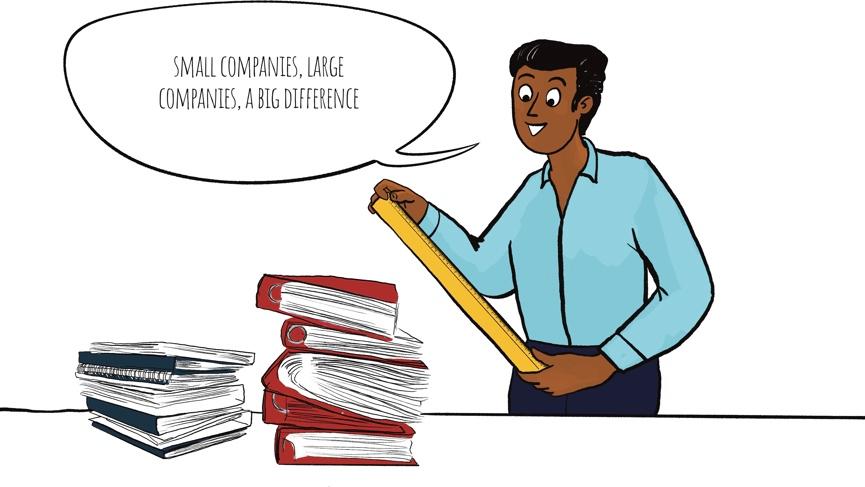
Recently, the thresholds for qualifying small companies were changed. This change was necessary as the thresholds were last adjusted in 2015 and given the inflation known since then. As a result, certain companies previously considered large will now qualify as small companies with the important consequence that they will be able to enjoy the tax benefits specifically reserved for them. This will therefore make life much more pleasant for a lot of companies.
1. What exactly will change?
From financial year 2024 (for companies that keep their accounts per calendar year), the thresholds for determining the size of a company will change as follows:
| Old thresholds | New thresholds | |
| Annual average number of employees | 50 | 50 |
| Annual turnover (excluding VAT) | EUR 9,000,000.00 | EUR 11,250,000.00 |
| Balance sheet total | EUR 4,500,000.00 | EUR 6,000,000.00 |
A company is considered small if it exceeds at most one of these thresholds on the balance sheet date of the last completed financial year.
In principle, the transition from a large to a small company occurs only in the event of exceeding at most one of these thresholds for two consecutive years. Consequently, the transition must be somewhat durable.
Fortunately, it is now temporarily accepted that a one-off exceeding of at most one of the new thresholds will suffice for a large company to be considered as a small company.
Consequently, a company that was large under the old thresholds in the 2023 financial year but small under the new thresholds in the 2024 financial year will immediately be considered a small company.
2. Tax benefits for small companies
Small companies enjoy various tax benefits, including :
- the application of the lower tax rate of 20% on the taxable base up to EUR 100,000;
- the possibility to distribute (liquidation) dividends at a reduced withholding tax rate under application of the VVPRbis regime or through the creation of a liquidation reserve;
- the possibility of making use of the ordinary one-off investment deduction, on the basis of which one may deduct a percentage of the acquisition or investment value of certain investments, carried out during the taxable period, from the taxable profit;
- the creation of an exempt investment reserve;
- the exception to the basket limitation for the deduction of previous losses during the first four taxable periods from its formation;
- the tax reduction or exemption granted to private investors in start-up companies (through the acquisition of shares or for loans granted through the intervention of a recognised crowdfunding platform);
- the exemption from multiplication if no or insufficient advance payments were made during the first three years from incorporation.
In addition, small companies are subject to more lenient rules on annual accounts and publications.
While your company may not have been eligible for these various tax benefits in the past, this could potentially be the case from now on as a result of the changed threshold values. You should be aware of this and seek more information if needed.
Would you like to receive more information or be assisted by the Seeds of Law specialists? Please do not hesitate to contact us at +32 2 747 40 07 or at info@be.Andersen.com.
Discover more about this topic?
I am looking for a specialist in









See more articles

01.10.2026
•Real Estate, Renting and Co-ownership, Andersen in Belgium
New Code of Ethics for Real Estate Agents: More Than a Mere Update
On 21 September 2026, the Royal Decree of 20 July 2026 approving the new Code of Ethics of the Professional Institute of Real Estate Agents (BIV) was published in the Belgian Official Gazette. The new Code enters into force on 1 October 2026, the date on which the 2018 regulations are repealed.

29.09.2026
•Urban Planning and Environmental Law, Andersen in Belgium
Financially contributing to a spatial implementation plan (RUP) poses a risk to your permit
A developer who contributes financially to the drafting of a spatial implementation plan may thereby jeopardize their integrated environmental permit. This follows a ruling by the Council for Permit Disputes dated September 17, 2026. The ruling addresses a practice that is widespread throughout Flanders.

17.09.2026
•Urban Planning and Environmental Law, Andersen in Belgium
Health organisations to become part of the public concerned in urban and environmental permitting procedures
Non-governmental organisations dedicated to protecting human health will soon be able, like environmental protection organisations, to qualify as part of the “public concerned” in urban and/or environmental permitting procedures. This will broaden the range of organisations that may challenge a permitting decision, adding a new dimension to future permitting procedures.

08.09.2026
•Real Estate, Renting and Co-ownership, Andersen in Belgium
Flanders Cracks Down on Substandard Housing with Significantly Higher Fines
Are you renting out a home with serious quality defects? If so, you risk criminal prosecution. Starting today, penalties for renting substandard housing in Flanders will be significantly increased. A fine can reach up to 800,000 euros under aggravating circumstances. At the same time, judges will have greater discretion to tailor the penalty to the severity of the offense.