


Flanders Cracks Down on Substandard Housing with Significantly Higher Fines
Are you renting out a home with serious quality defects? If so, you risk criminal prosecution. Starting today, penalties for renting substandard housing in Flanders will be significantly increased. A fine can reach up to 800,000 euros under aggravating circumstances. At the same time, judges will have greater discretion to tailor the penalty to the severity of the offense.
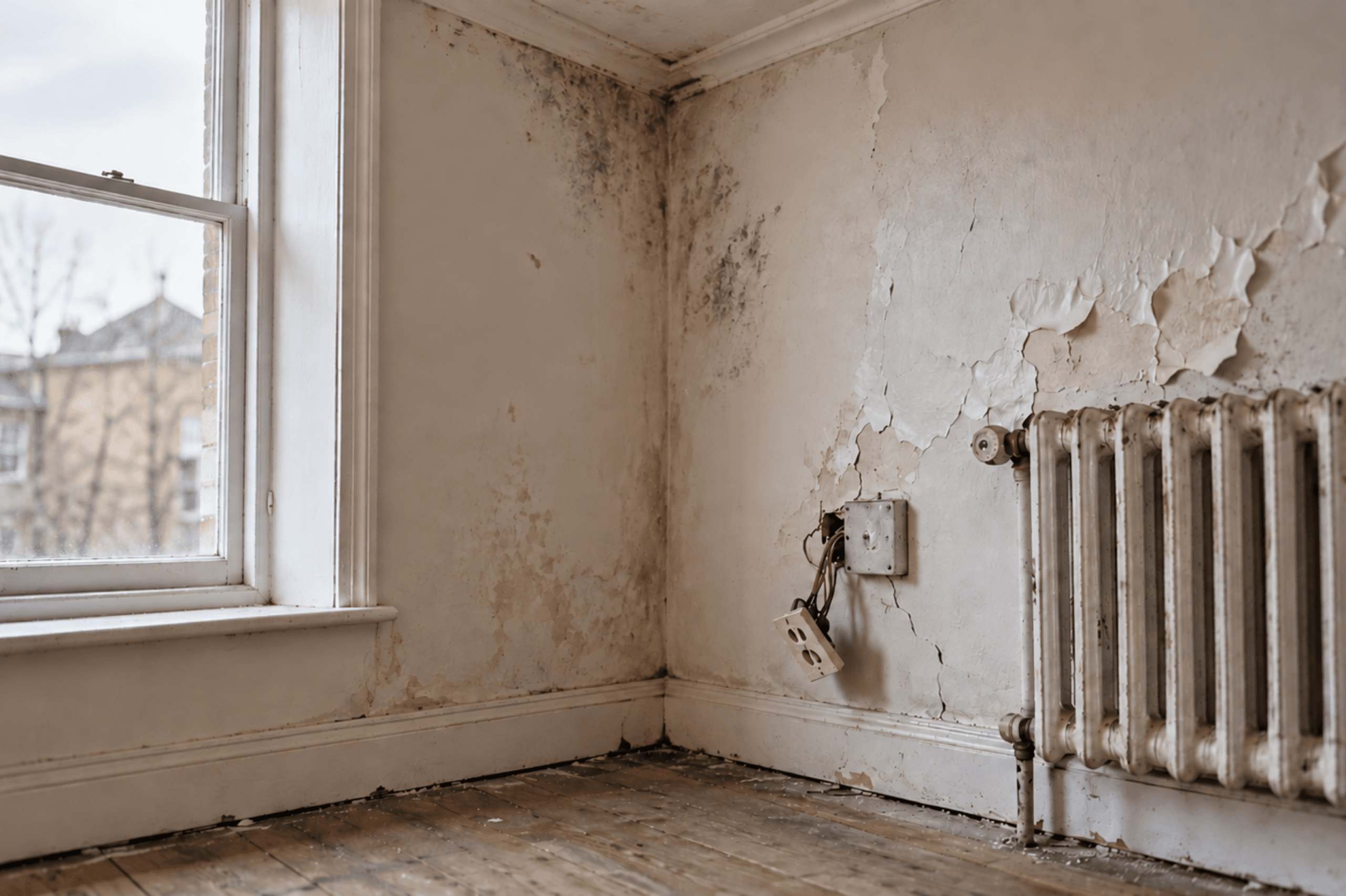
What is substandard housing?
The Flemish Housing Code (‘Vlaamse Codex Wonen’ or VCW) requires every residence to meet minimum quality standards. These include adequate structural stability, fire safety, or a healthy indoor environment.
Anyone who rents out, offers for rent, or makes available a dwelling that does not meet these standards is committing a crime (Articles 3.34 and 3.35 VCW). This is commonly referred to as ‘substandard housing’.
This is not the same as slumlord practices, in which a landlord deliberately exploits a tenant’s vulnerable position. Such a vulnerable position is not required for substandard housing.
Until recently, renting substandard housing was punishable by a prison sentence of six months to three years and a fine of 500 to 25,000 euros, or by one of these penalties alone.
In cases involving aggravating circumstances, such as when the activity had become a habitual practice, the penalty increased to a prison sentence of one to five years. The fine could then range from 1,000 to 100,000 euros.
What is changing today?
The Flesmish decree of June 3, 2026, amending various decrees regarding the second general implementation of the Flemish Enforcement Framework Decree (‘Kaderdecreet Vlaamse Handhaving’ or KVH), takes effect on September 8, 2026. This also revises the penal provisions of Articles 3.34, 3.35, and 3.36 of the VCW.
Penalties will henceforth be expressed according to the new penalty level system of the Penal Code, which was reformed in 2024 and has been in effect since September 1, 2026. Article 36 of the Penal Code sets out the levels for natural persons, while Article 38 of the Penal Code sets out those for legal entities.
In the context of substandard housing rentals, levels 1, 2, and 3 are relevant in each case. For both natural persons and legal entities, the principal penalties can range from a fine to the closure of the establishment or a prison sentence, depending on who is involved.
The basic offense, namely the rental of substandard housing (Articles 3.34 and 3.35 of the VCW), will be punishable by a Level 2 or Level 1 penalty, with the maximum fine always amounting to 200,000 euros. In the case of aggravating circumstances, namely, habitual engagement or participation in an association (Article 3.36 VCW), Level 3 or 1 applies, and the maximum fine is always 800,000 euros.
At the same time, this implies that the legislature has deliberately chosen to give the judge the option, in deviation from the provisions of the Penal Code, to opt for a Level 1 penalty where appropriate, even when a Level 2 or 3 penalty could be imposed. This gives the judge greater discretion to tailor the penalty to the severity of the offense.
What does this mean for you?
Do you rent out properties or advise landlords in Flanders? If so, make sure the property meets the minimum quality standards before you rent it out or make it available.
If you do find yourself involved in a case involving the rental of substandard housing, it is not only the amount of the potential fine that matters. The court has, in fact, been given greater discretion. This can be an important consideration when assessing the criminal risks and formulating a defense in a specific case.
Our specialists at Team Real Estate are happy to assist you with advice on enforcement and liability in real estate leasing.
Discover more about this topic?
I am looking for a specialist in


See more articles

05.11.2026
•Employment Law, Andersen in Belgium
Belgium imposes new workplace regulations
Employers must make sure that their internal policies are up date according to Belgium’s PIA and prepare for a stricter time registration obligation.

03.11.2026
•Tax Law, Andersen in Belgium
No Exact Correlation Required Between Expenses Relating to a Holiday Residence and Benefits in Kind
In its judgment of 18 June 2026, the Belgian Court of Cassation settled an important question concerning the deductibility of expenses incurred in making a holiday residence available to a company director: must these expenses be capped at the amount of the benefit in kind (BIK) taxed in the hands of the director? The Court answered in the negative.

03.11.2026
•Tax Law, Andersen in Belgium
Copyright and Tax Abuse: The Court of Cassation Gets Its Wires Crossed!
In a rather surprising judgment of 14 September 2026 (F.23.0097.F), the Belgian Court of Cassation failed to correctly identify the legislature's objectives when introducing the flat-rate tax regime for copyright and related rights income. The courts should swiftly distance themselves from this judgment!

02.11.2026
•Tax Law, Event
Our Partner Sébastien Watelet at Cafés-Conseils
On December 3rd our Tax Partner Sébastien Watelet will hold a conference during the 3rd edition of Inspirations, a Cafés-Conseils (UCM) event dedicated to accounting professionals.