


VAT: Demolition/Reconstruction: Deal kept?
In order to avoid contradicting rules in our country's various regions, the federal government had announced in its coalition agreement that it was essential that projects carried out by professionals could also be marketed at the reduced VAT rate of 6% for demolition and reconstruction.
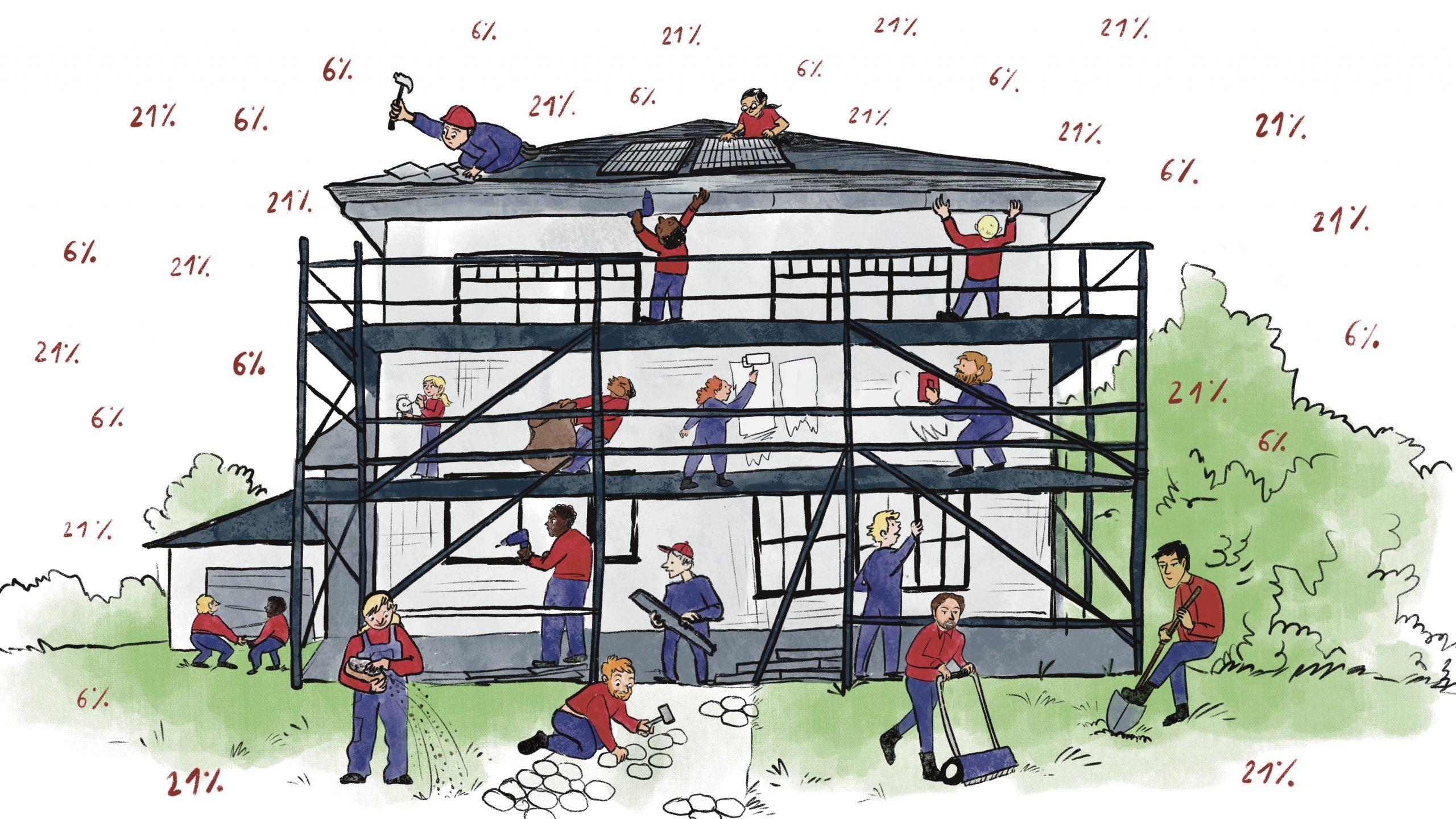
The reduced rate of 6% was to apply to everyone!
As a result, current social conditions would be maintained, and the surface criterion would be tightened from 200m2 to 175m2 for delivery.
The draft program law mentions the following different situations:
- For the principal – individual, the conditions for obtaining the scheme will be (unless amended):
- After completion of the work:
- The principal-individual uses the building as the sole and principal owner occupied dwelling and establishes its domicile there ;
- The living surface area is maximum 200m2 ;
- Electronic declaration to the Minister of Finance (+ copy to service providers):
- The planning permission; and
- The building contracts;
- Tax due no later than 31/12 of the year of first occupation;
- Invoices issued by the service providers must mention the elements justifying the application of the reduced rate, to release the service providers from their liability.
- Invoices issued by the service providers must mention the elements justifying the application of the reduced rate, to release the service providers from their liability.
- Invoices issued by the service providers must mention the elements justifying the application of the reduced rate, to release the service providers from their liability.
- After completion of the work:
- The reduced rate will still be applied to current social benefits (long-term social rental).
- For the principal – legal entity – the conditions for obtaining the scheme will be (unless amended):
- Demolition-reconstruction of a building located on the same cadastral parcel;
- Tax liability from June 1, 2025;
- Destination:
- for own and sole habitation of an individual whose living area is maximum 175m2
- for long-term social rental
- for long-term rental to an individual whose living area is maximum 200m2
- Electronic declaration before the time when the tax becomes due or in the case of sale on plan before the time when the taxable event occurs by attaching (+ in case of co-contractor – copy given):
- the planning permission
- the building contracts
- the private agreement or notarial deed.
- Invoices issued by service providers must mention the elements justifying the application of the reduced rate, to release the service providers from their liability.
- For long-term rental, the following conditions must be met:
- After completion of the work:
- Use as the sole and principal dwelling of the individual owner;
- Living surface area of maximum 200m2 ;
- Electronic declaration to the Minister of Finance appended (+ copy to service providers):
- the planning permission; and
- the building contract;
- Tax due no later than 31/12 of the year of first occupancy;
- Invoices issued by service providers must mention the elements justifying the application of the reduced rate to release the service providers from their liability.
- After completion of the work:
This is good news for property developers, although the difference in surface area maybe discriminatory and unfounded. In addition to using controversial criteria, the differences in figures are meaningless.
Discover more about this topic?
I am looking for a specialist in










See more articles

01.10.2026
•Real Estate, Renting and Co-ownership, Andersen in Belgium
New Code of Ethics for Real Estate Agents: More Than a Mere Update
On 21 September 2026, the Royal Decree of 20 July 2026 approving the new Code of Ethics of the Professional Institute of Real Estate Agents (BIV) was published in the Belgian Official Gazette. The new Code enters into force on 1 October 2026, the date on which the 2018 regulations are repealed.
29.09.2026
•Urban Planning and Environmental Law, Andersen in Belgium
Financially contributing to a spatial implementation plan (RUP) poses a risk to your permit
A developer who contributes financially to the drafting of a spatial implementation plan may thereby jeopardize their integrated environmental permit. This follows a ruling by the Council for Permit Disputes dated September 17, 2026. The ruling addresses a practice that is widespread throughout Flanders.

17.09.2026
•Urban Planning and Environmental Law, Andersen in Belgium
Health organisations to become part of the public concerned in urban and environmental permitting procedures
Non-governmental organisations dedicated to protecting human health will soon be able, like environmental protection organisations, to qualify as part of the “public concerned” in urban and/or environmental permitting procedures. This will broaden the range of organisations that may challenge a permitting decision, adding a new dimension to future permitting procedures.
08.09.2026
•Real Estate, Renting and Co-ownership, Andersen in Belgium
Flanders Cracks Down on Substandard Housing with Significantly Higher Fines
Are you renting out a home with serious quality defects? If so, you risk criminal prosecution. Starting today, penalties for renting substandard housing in Flanders will be significantly increased. A fine can reach up to 800,000 euros under aggravating circumstances. At the same time, judges will have greater discretion to tailor the penalty to the severity of the offense.