


Brussels winter moratorium violates human rights?
The Justice of the Peace of Ixelles was recently asked whether the winter moratorium, provided for in the Brussels Housing Code, entered into force by the ordinance of 22 June 2023 in the Brussels Capital Region, does not violate the European Convention on Human Rights (hereafter ECHR), and more specifically Article 1 of the First Protocol. In what follows, we will first briefly explain what exactly this mini moratorium entails, then discuss the judgment of the Justice of the Peace of Ixelles.
1. Brussels winter moratorium
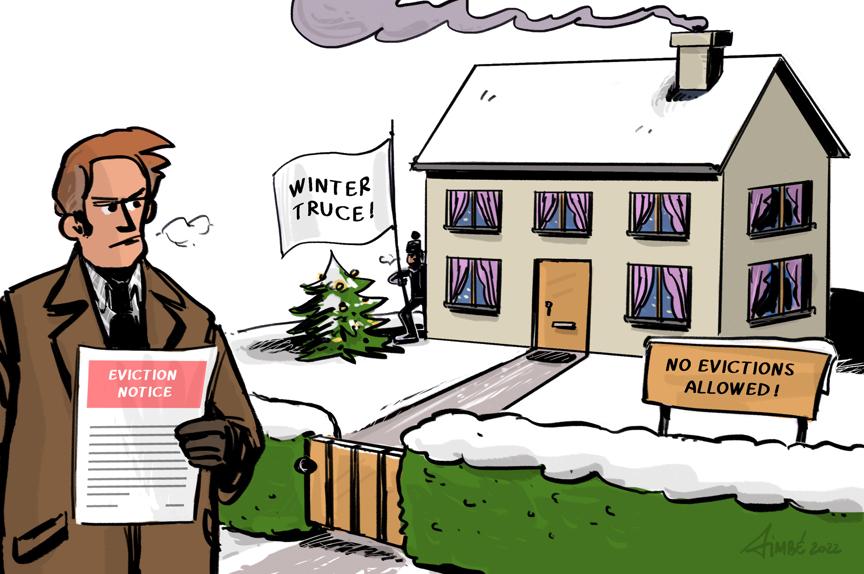
The Brussels Housing Code provides for a general moratorium on eviction during the winter months. This means that no evictions may take place between 1 November and 15 March. This measure took effect on 31 August 2023.
There are four limited exceptions to this ban. For example, it is allowed to deviate from the ban on evictions if:
- a rehousing solution is available or the tenant has left the property;
- the dwelling constitutes a health or safety hazard for its occupants;
- the tenant’s behaviour is at the basis of a dangerous condition that makes any further occupation impossible;
- the landlord finds himself in a situation of force majeure requiring him to personally occupy the dwelling.
2. The judgment of the justice of the peace of Ixelles
2.1 What was on?
In a first judgment, the judge declared valid the notice that a landlord had given to his tenant on 27 April 2023 and decided that the lease had ended on 31 October 2023.
However, the tenant did not intend to leave the property voluntarily and had also clearly stated his intentions in this regard. As the tenant did not wish to leave voluntarily, the landlord asked the justice of the peace of Ixelles to rule that the moratorium stipulated in the Brussels Housing Code was in breach of article 1 of the First Protocol to the ECHR and consequently not to apply this article and to allow the eviction one month after the service of the judgement. In other words, the landlord wanted the tenant evicted during the winter moratorium.
2.2 The judgment
A court can only apply national rules if they do not conflict with international rules with a direct effect in the domestic legal order. This is what is called “the primacy of international law” and has been accepted by the Supreme Court since its decision of 27 May 1971.
It is up to the court to ensure compliance with this hierarchy and to verify whether the rules expected to be applied do not conflict with higher norms of international law. If these domestic rules and regulations are found to be in conflict with the higher standard, then these internal rules regulations may not be applied.
The ECHR and its additional Protocols have direct effect in our Belgian legal system. This means that the courts must declare any Belgian norm that conflicts with it not applicable.
In this case, more specifically, the landlord called upon a violation of Article 1 of the First Additional Protocol, which protects the right to property.
This article reads as follows:
“Every natural or legal person is entitled to the peaceful enjoyment of his possessions. No one shall be deprived of his possessions except in the public interest and subject to the conditions provided for by law and by the general principles of international law. The preceding provisions shall not, however, in any way impair the right of a State to enforce such laws as it deems necessary to control the use of property in accordance with the general interest or to secure the payment of taxes or other contributions or penalties.”
When a legislator wishes to curtail this right of undisturbed enjoyment of property, it must strike the right balance between the public interest sought by the curtailment and the right to property.
In its decision regarding the conflict of the winter moratorium in the Brussels Housing Code with Article 1 of the First Additional Protocol, the judge relied on the advice of the Council of State on the ordinance in question.
The Council of State considers that the moratorium stipulated in the Brussels Housing Code does not strike a correct balance between the interests of the tenant on the one hand and the interests of the landlord/owner on the other hand, making this measure an excessive restriction on the right on property.
The Justice of Peace of Ixelles follows this advice and concludes that the winter moratorium in Brussels violates Article 1 of the First Additional Protocol to the ECHR. As a result, the relevant article in the Brussels Housing Code should not be applied.
3. Conclusion
Both tenants and landlords are thus warned that in the future the winter moratorium in the Brussels Capital Region may be declared inapplicable by judges because it may conflict with Article 1 of the First Additional Protocol of the ECHR.
It will remain to be seen to what extent this opinion will continue to be applied by the courts.
If you require more information, please do not hesitate to contact our specialists via info@be.Andersen.com or +32 (0)2 747 40 07.

Discover more about this topic?
I am looking for a specialist in


See more articles

01.10.2026
•Real Estate, Renting and Co-ownership, Andersen in Belgium
New Code of Ethics for Real Estate Agents: More Than a Mere Update
On 21 September 2026, the Royal Decree of 20 July 2026 approving the new Code of Ethics of the Professional Institute of Real Estate Agents (BIV) was published in the Belgian Official Gazette. The new Code enters into force on 1 October 2026, the date on which the 2018 regulations are repealed.

29.09.2026
•Urban Planning and Environmental Law, Andersen in Belgium
Financially contributing to a spatial implementation plan (RUP) poses a risk to your permit
A developer who contributes financially to the drafting of a spatial implementation plan may thereby jeopardize their integrated environmental permit. This follows a ruling by the Council for Permit Disputes dated September 17, 2026. The ruling addresses a practice that is widespread throughout Flanders.

17.09.2026
•Urban Planning and Environmental Law, Andersen in Belgium
Health organisations to become part of the public concerned in urban and environmental permitting procedures
Non-governmental organisations dedicated to protecting human health will soon be able, like environmental protection organisations, to qualify as part of the “public concerned” in urban and/or environmental permitting procedures. This will broaden the range of organisations that may challenge a permitting decision, adding a new dimension to future permitting procedures.

08.09.2026
•Real Estate, Renting and Co-ownership, Andersen in Belgium
Flanders Cracks Down on Substandard Housing with Significantly Higher Fines
Are you renting out a home with serious quality defects? If so, you risk criminal prosecution. Starting today, penalties for renting substandard housing in Flanders will be significantly increased. A fine can reach up to 800,000 euros under aggravating circumstances. At the same time, judges will have greater discretion to tailor the penalty to the severity of the offense.