


How can farming lease payments be made? Is payment in kind still possible? Is there still a maximum lease price?
Flemish Farming Lease Decree explained (Part 9). This article delves into the methods of fulfilling farming lease payments, the existence of a maximum lease price, the potential for disputes over payment, and the conditions under which a farming lease price can be revised or increased.
1. The farming lease price
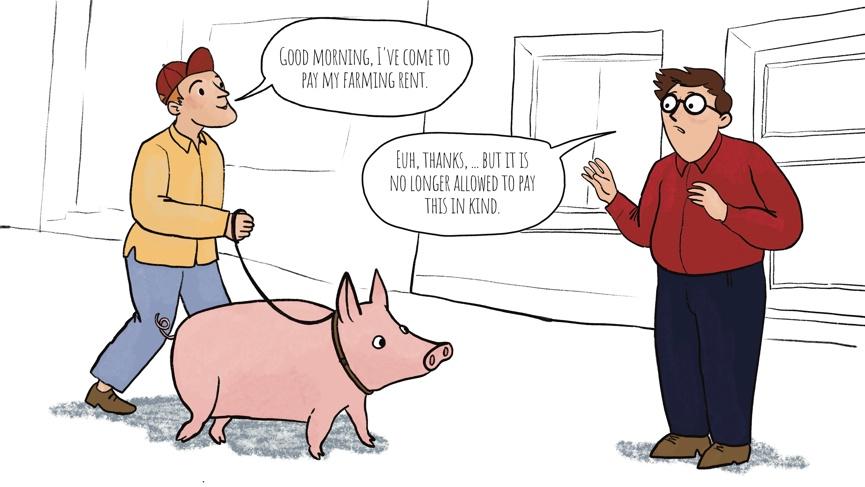
The Farming Lease Law establishes the rules for farming lease payments, often creating practical challenges by allowing payment in kind or services. The judiciary has broadly interpreted these provisions, often resulting in parties unintentionally falling under the jurisdiction of the Farming Lease Law. To limit this broad interpretation, the Farming Lease Decree stipulates that payment can only be made in cash, regardless of the provisions of the farming lease agreement.
The lessor or their authorized representative is obliged to provide the lessee with a receipt for the lease payment received, specifying the actual amount paid. Notwithstanding any conflicting agreement, the lessee may pay the lease price via postal assignment, postal check, money order, or bank transfer to the account of the lessor, one of the lessors, or their agents. This method of payment serves as proof of payment, unless contested by the lessor, who must bring the dispute before the court within six months of the payment date, under penalty of forfeiture. Proof of payment and the amount thereof may be established by any legal means, including witness testimony and presumptions.
2. The maximum allowable lease price
The law regulating farming lease prices previously established the rules for determining the maximum allowable lease prices. The maximum price was calculated by multiplying the cadastral income of the leased property by a farming lease price coefficient, set per province and agricultural region by the farming lease price committees.
The rules for establishing these committees are included in the Farming Lease Decree, consolidating all statutory rules regarding leasing into a single text, thus enhancing clarity. The rules concerning the limitation of farming lease prices are partially incorporated into the Farming Lease Decree. New provisions grant the farming lease price committees an expanded basis for negotiating new farming lease price coefficients.
Henceforth, these coefficients will be determined based on two criteria:
a. The ratio between the average profitability of businesses in each agricultural region over a three-year period preceding the last year of each term, and the average profitability during the same period of the previous term;
b. The unrealized increase or decrease in value resulting from land price changes during the three-year period preceding the last year of each term.
The first criterion is decisive. Consequently, an increase in unrealized land value should have a price-reducing effect, while a decrease should have a price-increasing effect, as the lessee will eventually realize a higher return from the increased property value. This is particularly relevant for contracts with a termination option for alienation.
3. Can a farming lease price be increased?
Under the Farming Lease Decree, the farming lease price for agreements executed by authentic deed may be increased as follows:
- by 36% for land and 18% for buildings if the initial usage period is at least 18 years;
- by 42% for land and 21% for buildings if the initial usage period is at least 21 years;
- by 48% for land and 24% for buildings if the initial usage period is at least 24 years;
- by 50% for land and 25% for buildings if the initial usage period is 25 years or more.
After the initial usage period, the lease price reverts to the maximum allowable lease price. In the context of career leases, the maximum lease price may be increased by 50% for land and 25% for buildings.
4. Can a farming lease price be reviewed?
The Farming Lease Decree also includes provisions for the review of farming lease prices. Either party may request a review of the price of an ongoing farming lease if it deviates from the current maximum allowable farming lease price. If a lessee requests a review of a lease price that exceeds the maximum allowable price, the lease is not nullified; instead, the price is adjusted to the maximum allowable amount.
The lessor’s request for a farming lease price adjustment takes effect only on lease prices due after the notification date of the price adjustment. Overpayments above the maximum allowable lease price may be refunded to the lessee upon request, applicable only to lease payments that have accrued and been paid in the five years preceding the request. The lessee’s claim for a refund expires one year after the date they vacate the leased property.
If you require more information, please do not hesitate to contact our specialists via info@be.Andersen.com or +32 (0)2 747 40 07.
Discover more about this topic?
I am looking for a specialist in


See more articles

01.10.2026
•Real Estate, Renting and Co-ownership, Andersen in Belgium
New Code of Ethics for Real Estate Agents: More Than a Mere Update
On 21 September 2026, the Royal Decree of 20 July 2026 approving the new Code of Ethics of the Professional Institute of Real Estate Agents (BIV) was published in the Belgian Official Gazette. The new Code enters into force on 1 October 2026, the date on which the 2018 regulations are repealed.
29.09.2026
•Urban Planning and Environmental Law, Andersen in Belgium
Financially contributing to a spatial implementation plan (RUP) poses a risk to your permit
A developer who contributes financially to the drafting of a spatial implementation plan may thereby jeopardize their integrated environmental permit. This follows a ruling by the Council for Permit Disputes dated September 17, 2026. The ruling addresses a practice that is widespread throughout Flanders.

17.09.2026
•Urban Planning and Environmental Law, Andersen in Belgium
Health organisations to become part of the public concerned in urban and environmental permitting procedures
Non-governmental organisations dedicated to protecting human health will soon be able, like environmental protection organisations, to qualify as part of the “public concerned” in urban and/or environmental permitting procedures. This will broaden the range of organisations that may challenge a permitting decision, adding a new dimension to future permitting procedures.

08.09.2026
•Real Estate, Renting and Co-ownership, Andersen in Belgium
Flanders Cracks Down on Substandard Housing with Significantly Higher Fines
Are you renting out a home with serious quality defects? If so, you risk criminal prosecution. Starting today, penalties for renting substandard housing in Flanders will be significantly increased. A fine can reach up to 800,000 euros under aggravating circumstances. At the same time, judges will have greater discretion to tailor the penalty to the severity of the offense.